How to Scale Enterprise DevOps Automation: A Strategic Playbook for US Tech Leaders
In today's enterprise technology landscape, the speed of software delivery has stopped being just an operational metric it's now a genuine competitive advantage. For US enterprises, and especially those competing inside California's high-pressure tech hubs, the demand to ship polished features quickly keeps intensifying.
The instinctive response is often to add more tools to the stack. But growing a toolchain without a unifying strategy tends to create new headaches instead of solving old ones. Tool sprawl, disconnected pipelines, and siloed teams open up a real performance gap. Closing it takes more than a handful of scripts it requires a deliberate, organization-wide approach to scaling enterprise DevOps automation.
When internal teams don't have the time or specialized expertise to close these gaps on their own, bringing in a dedicated DevOps consulting company is often what turns things around, laying the groundwork for sustainable technical growth.
.jpg)
The Enterprise Automation Gap: Breaking Down Tooling Silos
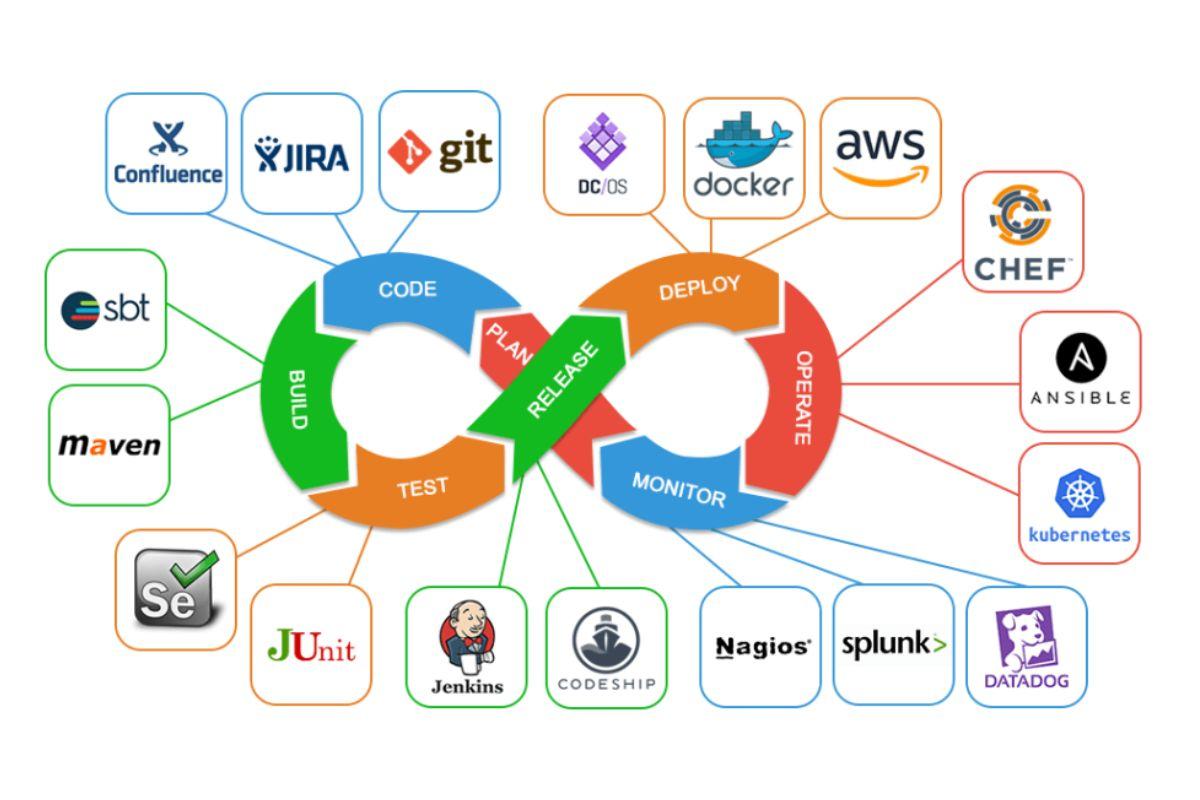
DevOps is often pictured as a smooth, continuous loop, where each development stage flows naturally into operations. In practice, large enterprises run into fragmentation at nearly every point in that cycle:
Plan & Code — backlogs tracked in isolation and source control practices that shift from team to team
Build & Test — patchwork CI setups that create bottlenecks before code ever reaches production
Release & Deploy — deployment scripts that do not hold up unswervingly across hybrid or multi-cloud infrastructure
Operate & Monitor — constant reactive firefighting caused by monitoring tools that don't talk to one another
Once these systems stay siloed, the loop breaks down. Closing these integration gaps calls for a deliberate, top-down strategy and that's exactly where experienced enterprise DevOps consulting services help organizations build automation frameworks that are unified and repeatable.
The Strategic Framework: Four Pillars of a Scaled DevOps Lifecycle
Scaling automation across a Fortune 500 company or a fast-growing California enterprise comes down to four foundational pillars.
1. Standardize Infrastructure as Code (IaC)
Manual infrastructure provisioning is arguably the biggest threat to both delivery speed and system security. Scaling automation means treating infrastructure the same way you'd treat application code. Tools like Terraform or AWS CloudFormation let teams define cloud-native environments declaratively, keeping staging, testing, and production identical eliminating the deployment issues caused by environment drift.
2. Shift Compliance Left
For US enterprises, compliance isn't optional. California organizations in particular have to navigate strict state-level data privacy laws on top of federal frameworks such as HIPAA, SOC 2, and PCI-DSS.
Rather than treating security as a last-minute roadblock, leading engineering teams build compliance directly into the CI/CD pipeline. Automated vulnerability scanning, static code analysis, and policy enforcement run continuously during the build phase, putting guardrails in place without slowing delivery down.
3. Orchestration and Cloud-Native Architecture
Legacy, single-tier architectures put a hard ceiling on how far automation can scale. Real scalability comes from moving toward microservices and cloud-native designs managed through container orchestration platforms like Kubernetes. This is exactly where an experienced DevOps consulting company proves its value mapping out complex cloud migrations so infrastructure can expand automatically as live traffic grows.
4. Build Self-Service Developer Platforms (IDPs)
Real scale is achieved when engineering teams can provision resources independently, without waiting on a centralized ops group. Internal developer platforms (IDPs) give developers ready-made templates and automated workflows, letting them spin up safe, compliant environments in just a few clicks boosting velocity while keeping governance fully intact.
Full Lifecycle Optimization: Aligning Dev and Ops
Building genuine topical authority and a truly high-performing engineering culture means addressing every phase of the pipeline systematically:
Unified build frameworks — standardized containerization so artifacts move from a developer's laptop to production with zero friction
Automated quality gates — rigorous automated testing built directly into build pipelines, eliminating delays from manual review
Continuous monitoring feedback — real-time performance data that feeds production insights straight back into planning
.jpg)
Measuring the Business ROI of Scaled Automation
Automation is a real financial and operational investment, so it has to earn its place beyond vanity metrics. Enterprise leaders typically track:
Faster time-to-market — turning release cycles that once took months into a matter of minutes, so you ship ahead of competitors
Fewer errors — automated testing catches bugs earlier, meaningfully reducing production incidents
Smarter cloud spend — automated provisioning tears down unused resources, cutting wasted cloud costs
Stronger engineering retention — automating tedious deployment work frees developers for radical innovation, which shows up directly in job satisfaction
Conclusion: Partner with Experts to Fast-Track Your Evolution
.jpg)
Learning how to scale enterprise DevOps automation isn't a project with a finish line it's an ongoing process of cultural alignment and digital transformation. Trying to navigate that shift with internal resources alone often leads to costly delays, tool fatigue, and hidden security gaps.
Don't let legacy processes hold your business back. Partnering with a leading DevOps consulting company gives you immediate access to battle-tested delivery frameworks, top-tier cloud architects, and workflow strategies built for your specific stack.
Ready to transform your software deployment pipeline and outpace the market? Explore our specialized DevOps consulting services to see how we build high-performing engineering cultures or book a free DevOps consultation with our team today.